World Mental Health Day is held every year on 10 October. This year’s theme is: It is Time to Prioritise Mental Health in the Workplace.
Our Workplace Wellbeing Training team has pulled together some great tips for wellbeing that you can practice in the workplace and at home.
For the majority of us, ‘tumble out of bed and stumble to the kitchen,’ is an everyday reality as we make our way to work. But as Dolly Parton so aptly said, ‘working 9-5 what a way to make a living, barely getting by it’s all takin’ and no givin,’ we’re burning out and in 2026, the reality of our work context, it’s less 9-5 and more 24/7.
Coupled with more fractured communities, people living further away from family support, the cost of living crisis, hybrid working adding to isolation and an optimisation culture, which emphasises hustle and constant availability – is it any wonder, 61% of UK employees said they left jobs, or planned to leave in the next 12 months, because of poor mental health (according to Working days lost in Great Britain – HSE)?
For us in the Buckinghamshire Mind Training Service, this is our call to action, our cup of ambition, so to speak. Whilst systematic challenges can’t be overcome overnight, we can equip employees with the skills and knowledge to build resilience, self-awareness around their own capabilities and hopefully have preventative measures in place, so burnout doesn’t equate to poor mental health (or exacerbate an existing condition).
What we know is our daily routines and lifestyle choices play a crucial role in how we experience and manage stress and are the foundation of our wellbeing. Whilst stress isn’t a diagnosed mental health illness, rather our response to pressure, it can be attributed to poor mental health and ultimately lead to illness.
Stress is a signal, not a weakness.
The choices you make around sleep, movement, nutrition, relaxation, and mindfulness directly impact your energy, mood and ability to cope with stress.
The following information is a starting point, not a destination. The info here is designed to be a guide, ultimately you choose what feels right and helpful for you.
You have the power to make meaningful changes, one small step at a time.
Daily Habits
Our first area to explore is our daily habits and how these may act as a preventative to burn out. Our daily routines and lifestyle choices play a crucial role in how we experience and manage stress and are the foundation of our wellbeing.
Often when we’re feeling under pressure, we adopt short-term practices to help us cope in the moment, such as reaching for a chocolate bar, or skipping lunch to, ‘just get things done’. These choices may provide immediate relief, but often have a long-term detrimental impact. The 5 pillars of daily balance are areas in our lives that we may want to explore to help provide opportunities to de-stress and ensure we’re not cutting corners when it comes to our health and wellbeing.
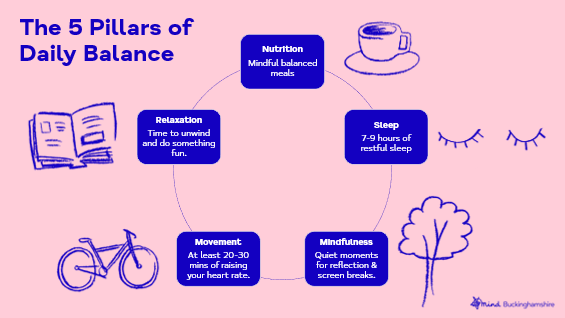
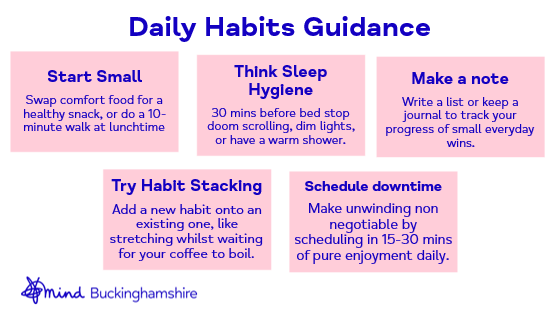
Trying to implement change, even positive change, can feel overwhelming whilst we’re experiencing a period of high stress. For this reason, here are a few ideas, which provide practical support on how we can implement the 5 pillars of daily balance into our everyday.
There is no rule book on when, or how to use these tips. As ever, pick and choose what feels most readily available to you and modify where needed. Roping in a colleague can often be an effective way of having accountability and makes implementing small changes feel much more doable. What new habit are you going to adopt this week?
Emotional Wellbeing & Coping
Daily habits build your foundation, but understanding your emotions strengthens the inner walls. We’ve explored daily routines now it’s time to turn our attention inward: our emotional wellbeing.
How we recognise, express and manage our emotions significantly affects how we cope with stress, make decisions and connect with others.
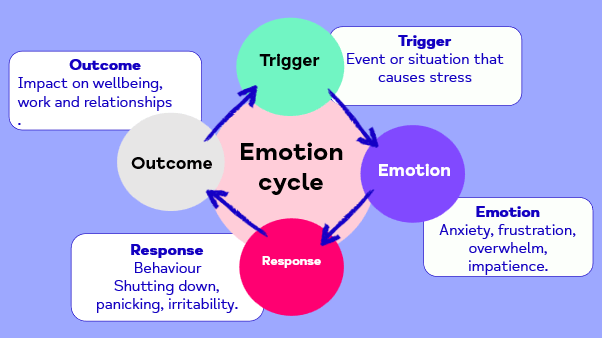
Remember: Wellbeing isn’t a destination — it’s a daily practice. Every small, mindful choice we make adds up to something powerful. Whether it’s a deep breath before a meeting, a walk after work, or reaching out for support — these are all signs of growth and self-care.
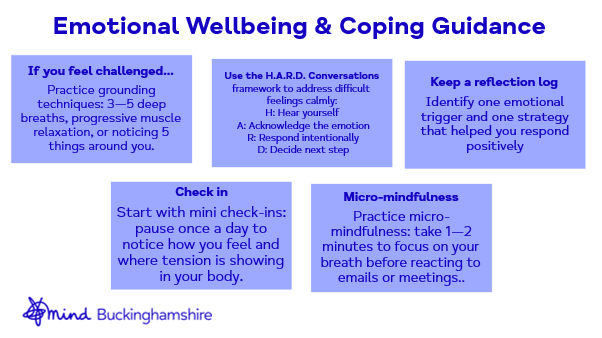
We can’t always control what happens around us — but we can shape how we respond, recharge and rise again. Here are some practical ideas about how we can look after our emotional wellbeing whilst at work.
When Tools Aren’t enough
Sometimes tools can help, sometimes they don’t.
If the feelings are not shifting, that is a sign you need more support, not a sign anything is wrong with you.
You might need support if you notice:
- Trouble sleeping
- Feeling detached or “switched off”
- Guilt, self-blame or feeling responsible for everyone
- Strong emotional reactions that surprise you
None of this means you are failing. It means the work is affecting you, and you need care too.
Feeling stressed, shaken or drained does not mean you are failing or “not strong enough”.
- Feeling affected by work does not mean you’re failing.
- What matters is paying attention to these feelings rather than dismissing them.
- Talking openly about these feelings early, with colleagues, volunteers or your organisation, helps prevent burnout and keeps everyone safer.
- Minor adjustments can prevent manageable strain from turning into overload.
If you experience ongoing physical or emotional symptoms, speak with your welfare lead or GP.
You do not need to cope alone.
Dolly Parton once said, ‘If you want the rainbow you’ve got to put up with the rain,’ but sometimes, you just need someone to pass you an umbrella. If you need somewhere to shelter, whilst you’re under a raincloud, Buckinghamshire Mind is here for you, you don’t have to be out in a storm alone.